A professional data platform must do more than move data correctly. It must make data discoverable, protected, accountable, and usable within clear rules. Earlier chapters built the data plane of TuranMart: relational and NoSQL stores, object storage, warehouse and lakehouse tables, batch and streaming pipelines, analytics transformations, orchestration, CI/CD, observability, and reliability. This chapter adds the control plane that allows those assets to be trusted in a real organization: governance, security, privacy, and compliance.
Governance is sometimes presented as committee work, but in production data engineering it is also engineering work. A policy saying that personal data must be protected is not enough. The platform must classify sensitive columns, attach owners, enforce access policies, mask or tokenize fields, encrypt storage, capture lineage, validate quality rules, retain or delete records according to policy, and preserve evidence for reviews and audits. If these controls are missing, a data lake or warehouse can quickly become a liability. Analysts cannot identify the authoritative table. Engineers cannot assess downstream impact. Privacy teams cannot answer access or deletion requests. Security teams cannot prove who exported sensitive records. Executives lose confidence precisely when the platform becomes important.
The stakes are material. IBM’s 2024 breach-cost research reported that the global average cost of a data breach reached USD 4.88 million, a 10 percent increase from 2023. The same analysis reported that 40 percent of breaches involved data spread across multiple environments, such as public cloud, private cloud, and on-premises systems; those multi-environment breaches cost more than USD 5 million on average and took 283 days to identify and contain.[1] This is the environment data engineers now operate: hybrid platforms, SaaS applications, notebooks, BI tools, event streams, lakehouses, orchestration systems, AI workloads, and exported files.
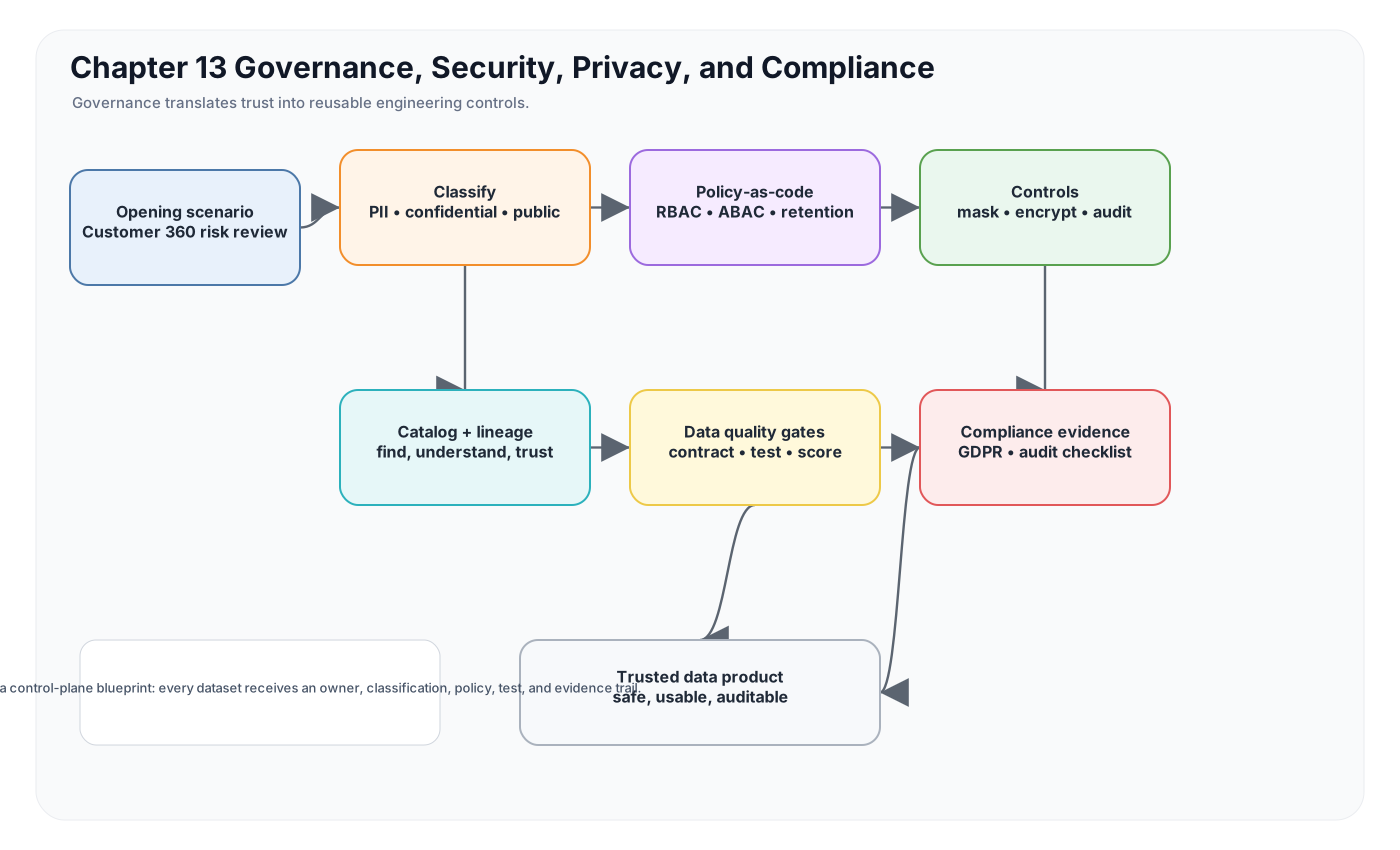
Figure 1:Chapter 13 treats governance as a data-platform control plane: each critical data product receives ownership, classification, access policy, quality rules, privacy workflow, retention policy, and audit evidence.
Opening Scenario: TuranMart’s Customer 360 Platform Becomes a Risk Surface
TuranMart has built a popular Customer 360 platform. It joins e-commerce orders, loyalty profiles, mobile-app events, delivery addresses, payment outcomes, customer-support tickets, marketing consent records, and warehouse fulfillment history. The first release is successful. Merchandising teams use it to segment customers. Logistics managers use it to understand delivery failures. Risk analysts use it to detect refund abuse. Product managers use it to study mobile-app funnels. Data scientists want the same tables for churn and fraud models.
Then the questions begin. Who owns the mobile-app events? Which tables contain phone numbers, passport numbers, exact addresses, device identifiers, or consent preferences? Can contractors see the gold customer table? Can marketing export high-value customer lists? Which downstream dashboards, feature tables, and notebooks will break if the customer_id mapping changes? If a customer requests deletion or restriction, which raw files, silver tables, gold marts, BI extracts, model-training snapshots, and backups must be considered? If an auditor asks who queried restricted customer fields last quarter, can the platform answer with evidence rather than memory?
This is the moment when governance stops being an abstract corporate function and becomes a practical engineering requirement. The platform needs a control plane around the data plane. The data plane stores, processes, and serves data. The control plane describes, classifies, protects, validates, authorizes, and audits data. A mature team does not ask whether a dataset is governed in the abstract; it asks whether a specific data product has an owner, a documented meaning, a sensitivity label, a data contract, a tested quality baseline, an access policy, a masking rule, a retention rule, lineage, and audit evidence.
The success criterion for this chapter is therefore concrete. By the end, TuranMart’s Customer 360 table should be represented by a governance contract, a classification register, a masking and access policy, automated quality checks, privacy-request guidance, and an audit-ready report. The lab is intentionally local and lightweight, because governance thinking should not require an enterprise catalog before the team can practice it.
Learning Objectives
By the end of this chapter, you should be able to design a governed data product rather than merely describe governance at a policy level. You should be able to classify data assets by sensitivity, map classifications to technical controls, compare role-based and attribute-based access patterns, explain how lineage supports privacy and impact analysis, implement practical quality and policy checks, and produce audit evidence for a sensitive dataset.
| Objective | What you should be able to do | Lab evidence |
|---|---|---|
| Explain governance as a control plane | Distinguish ownership, metadata, classification, policy enforcement, privacy workflow, and evidence. | Written governance summary in the generated report. |
| Classify sensitive data | Label columns as public, internal, confidential, identifier, PII, restricted PII, or privacy preference. | outputs/classification_register.csv. |
| Design access and masking controls | Map roles and attributes to raw, masked, aggregated, and export access. | outputs/access_policy_matrix.csv. |
| Validate governed data quality | Check keys, consent values, country codes, restricted-field propagation, and freshness. | outputs/governance_report.json. |
| Connect privacy and lineage | Identify where a customer record appears and which derived assets require review. | outputs/privacy_request_manifest.json. |
| Produce audit evidence | Package policy, classification, quality, access, and privacy artifacts into a reproducible checklist. | outputs/audit_checklist.md. |
You should also learn to translate legal and security language into engineering language. When a policy says that personal data must be minimized, the data engineer should think about column selection, derived fields, retention partitions, masking views, feature snapshots, and export controls. When a security team asks for least privilege, the data engineer should think about identities, roles, attributes, policy enforcement points, secrets, network paths, query logs, and periodic access review.
13.1 Governance as a Data-Platform Control Plane
Data governance is the management system that makes data available, understandable, trustworthy, secure, and accountable. It is not a one-time documentation sprint. It is an operating model that connects business ownership with technical controls. A useful governance program answers six recurring questions. What data exists? What does it mean? Who owns it? How sensitive is it? Who may use it, for which purpose, and under which conditions? What evidence proves that the rules were followed?
The NIST Privacy Framework describes privacy risk management as a voluntary tool that helps organizations identify and manage privacy risk while protecting individuals’ privacy.[2] For data engineers, this means privacy is not only a legal review; it is part of dataset design, pipeline behavior, access control, observability, and incident response.
A practical governance program has five pillars. The first is ownership. Every important data asset needs an accountable business owner and a technical steward. The owner decides meaning, criticality, acceptable use, and escalation paths. The steward maintains schema documentation, data-quality rules, lineage, runbooks, and implementation details. The second pillar is metadata. A platform cannot govern unknown data. Metadata includes schema, descriptions, owners, freshness, quality scores, lineage, classification tags, sample queries, usage patterns, incidents, and access history. The third pillar is classification. Data must be labeled by sensitivity so controls can be applied consistently. The fourth pillar is policy enforcement. Governance becomes real only when access, masking, retention, encryption, and quality rules are enforced by systems rather than remembered manually. The fifth pillar is evidence. A governed platform must show what happened: who accessed which data, what quality tests ran, what policy was applied, what exceptions were approved, and when controls were reviewed.
| Governance pillar | Engineering implementation | Typical evidence produced |
|---|---|---|
| Ownership and stewardship | Owner fields in catalog, steward queue, change-approval workflow, support channel | Owner registry, steward assignment, change approvals, escalation records |
| Metadata and cataloging | Automated schema crawlers, lineage extraction, glossary links, freshness and quality metadata | Catalog entry, schema history, lineage graph, documentation page, quality dashboard |
| Classification | Sensitive-data scanning, steward review, tags such as public, internal, confidential, and restricted_pii | Classification report, PII detection output, reviewed tags, exception notes |
| Policy enforcement | RBAC, ABAC, masking views, row filters, lifecycle policies, encryption configuration | Access policy, masking rule, retention log, key-management setting |
| Audit and evidence | Query logs, export logs, data-quality reports, incident records, access-review results | Audit trail, access-review sign-off, compliance checklist, incident postmortem |
A common mistake is to place governance “on top of” the platform after the platform is already built. This usually produces spreadsheets, meetings, and manual reviews but few enforceable controls. A better approach is to design governance into the architecture. The catalog should receive metadata from ingestion jobs. The orchestrator should record which contracts and quality checks ran. The warehouse should enforce masking policies. The object store should have encryption and lifecycle settings. The BI tool should inherit identity rather than create a shadow permission system. The CI/CD pipeline should reject schema changes that violate contracts for critical data products.
The best governance systems are also proportional. Not every dataset needs the same ceremony. A public product taxonomy used in tutorials may require versioning and documentation but not strict masking. A restricted customer table requires ownership, classification, least-privilege access, masking, privacy workflow, retention, audit logging, and periodic review. Proportional governance prevents both under-control and over-control. Under-control creates risk. Over-control creates shadow data copies and slows legitimate work.
13.2 Classification, Ownership, and Metadata
Classification is the bridge between business risk and technical control. A classification label should answer a practical question: what must the platform do differently because this data exists? If the label does not change access, masking, retention, review, or evidence, it is probably not useful.
TuranMart can begin with a compact classification scheme. Public data can be shared broadly, provided its integrity and source are clear. Internal data is safe for employees and approved contractors but should not be published externally without review. Confidential data includes financial, supplier, pricing, and business-strategy data. Identifier data uniquely identifies a person, account, device, order, or merchant. PII includes personal attributes such as name, phone, email, and address. Restricted PII includes highly sensitive fields such as passport number, government ID, precise location, payment token, or raw behavioral records linked to an individual. Privacy preference fields record consent, opt-out, deletion, or restriction states and must be treated as control fields, not merely descriptive attributes.
| Classification | TuranMart examples | Default access | Required controls |
|---|---|---|---|
| Public | Published help-center articles, public product categories | Broad access | Integrity check, source attribution, versioning |
| Internal | Operational logs without personal data, aggregated inventory metrics | Employees and approved contractors | SSO, basic RBAC, owner, retention policy |
| Confidential | Revenue margins, supplier contracts, pricing strategy | Need-to-know business roles | Strong RBAC, encryption, access review, export logging |
| Identifier | customer_id, order_id, loyalty account ID, device ID | Approved analytics and operational roles | Join-control review, lineage, tokenization where appropriate |
| PII | Name, phone, email, delivery address | Approved roles with business purpose | Masking, row/column policies, audit logs, retention rules |
| Restricted PII | Passport number, government ID, precise GPS, raw customer event history | Explicit approval and monitored use | ABAC, tokenization, strict export control, privacy workflow |
| Privacy preference | Consent flags, opt-out status, deletion restrictions | Controlled modification and broad read where needed for enforcement | Quality checks, immutable history where appropriate, policy integration |
Ownership is equally important. A customer table without an owner becomes a public utility with no maintenance budget. A schema change appears; nobody knows who can approve it. A data-quality incident appears; nobody knows who must respond. Ownership must therefore be stored as metadata and used in workflows. If a critical test fails, the steward receives the ticket. If an access exception is requested, the owner approves the purpose. If a privacy request touches the table, the owner confirms the handling rule.
Metadata should be generated as close as possible to the work that creates it. If a dbt model defines a transformation, it should also define descriptions and tests. If an Airflow DAG runs a pipeline, it should emit run status and lineage. If a warehouse applies a masking policy, the catalog should display that policy and classification. Manual editing is still necessary for business definitions and stewardship, but the catalog should not depend on manual copy-paste for facts the platform already knows.
13.3 Access Control, Masking, Encryption, and Secrets
Data security protects data against unauthorized access, disclosure, alteration, and destruction. In a modern data platform, security covers files, tables, streams, APIs, orchestration credentials, notebooks, dashboards, exports, backups, and machine-learning artifacts. The old assumption that everything inside a corporate network is trusted no longer works for cloud platforms, contractors, remote work, SaaS applications, notebooks, and AI services.
NIST’s Zero Trust Architecture states that zero trust moves defenses away from static network perimeters and toward users, assets, and resources. It assumes no implicit trust based only on physical location, network location, or asset ownership, and it requires authentication and authorization before a session to an enterprise resource is established.[3]
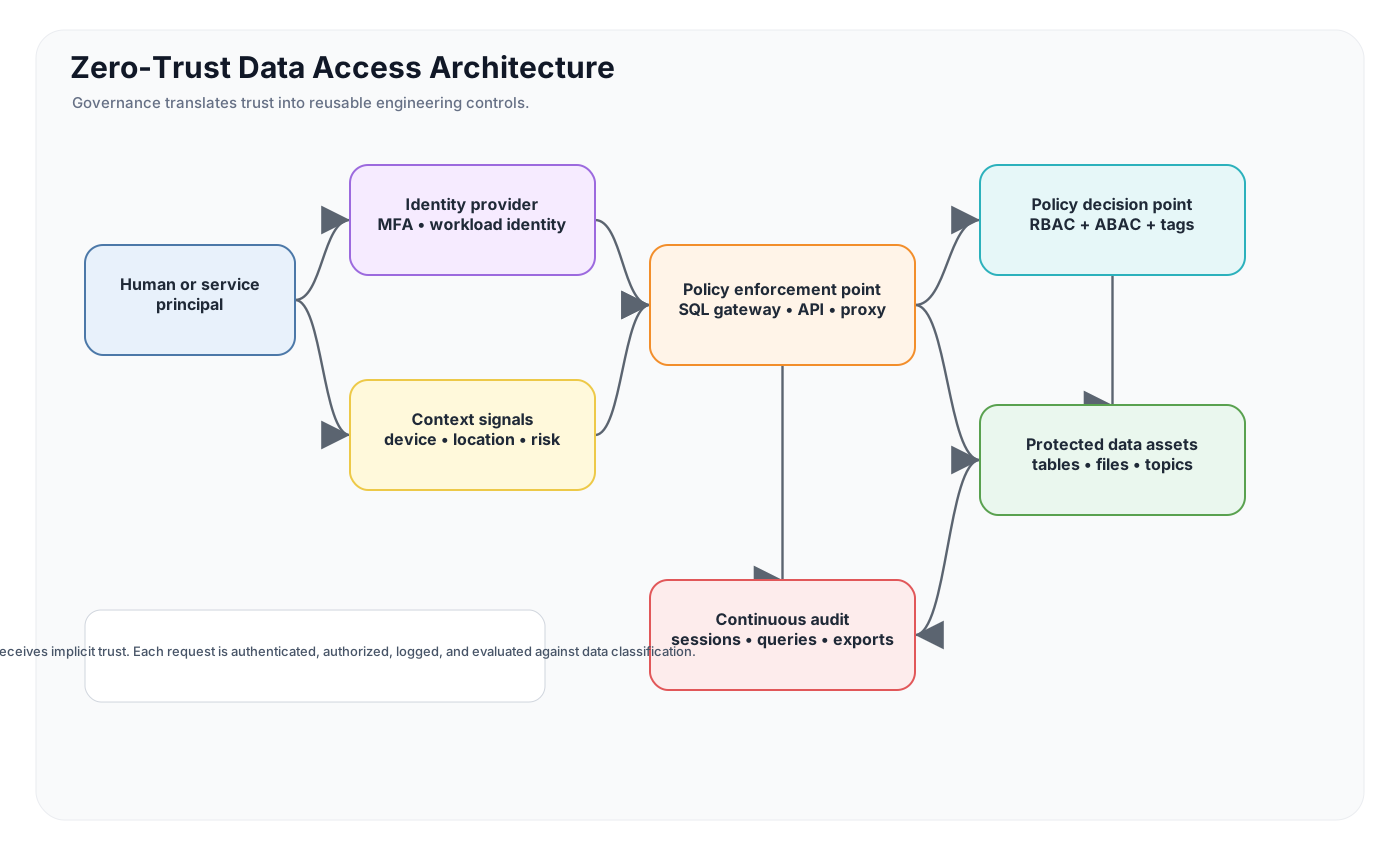
Figure 2:A zero-trust data access architecture evaluates identity, role, attributes, purpose, policy, and data classification before allowing access to tables, files, topics, APIs, dashboards, or exports.
The most important security design principle is least privilege. Users, service accounts, notebooks, jobs, and BI tools should receive only the permissions required for their work. Role-based access control (RBAC) grants permissions through roles such as data_analyst, data_engineer, finance_controller, or customer_support_agent. Attribute-based access control (ABAC) adds context such as department, region, purpose, data classification, device posture, approval state, and time window. A mature platform usually combines both. RBAC keeps administration understandable, while ABAC handles sensitive cases such as “fraud analysts in the risk team may query tokenized customer identifiers for an approved investigation in their assigned region.”
Masking reduces unnecessary exposure. A customer-service agent may need the last four digits of a phone number to verify identity but not the full value. A marketing analyst may need aggregate lifetime value bands but not raw passport numbers. A data scientist may need stable tokens for joins but not direct identifiers. Masking should be implemented in policy-controlled views, column policies, dynamic data masking rules, or service-layer responses rather than in ad hoc analyst notebooks. For high-risk identifiers, tokenization or hashing with appropriate key management may be preferable to simple masking.
Encryption is non-negotiable. Data should be encrypted at rest in databases, warehouses, lakehouse storage, object storage, backups, and local developer environments. Data should be encrypted in transit through TLS for service-to-service communication, database connections, API calls, and ingestion endpoints. Encryption does not replace access control, because authorized users can still misuse data, but it reduces exposure from stolen disks, intercepted traffic, misconfigured storage, or unintended copies.
| Control area | Practical data-platform control | Example implementation pattern |
|---|---|---|
| Identity | Central identity provider, MFA, workload identity for services | SSO for BI and notebooks; short-lived service tokens for jobs |
| Authorization | RBAC for broad roles and ABAC for sensitive conditions | Table grants by role; row filters by region; masking by classification tag |
| Masking and tokenization | Dynamic masks, token tables, approved unmasking workflows | Last-four phone view; salted token for government ID; aggregate-only revenue view |
| Encryption | Encryption at rest and in transit | Server-side object-store encryption; TLS database connections; managed keys |
| Secrets | No passwords or API keys in code, notebooks, or Git | Secret manager, runtime injection, scoped credentials, rotation logs |
| Audit | Query, export, permission, and admin logs | Central log sink with retention and alerting on unusual exports |
| Segmentation | Separate dev, test, and production data access | Synthetic data in dev; controlled production access through approved workflow |
Secrets management deserves special attention because data pipelines connect to many systems. Database passwords, API keys, OAuth tokens, warehouse credentials, and encryption keys must never be hard-coded in scripts, notebooks, YAML files, Docker images, or Git repositories. A pipeline should request secrets at runtime from a dedicated secrets manager, and those secrets should be rotated, scoped, and logged. Service accounts should be treated as first-class identities. In many incidents, non-human identities have broader access than people because they were created early and never reviewed.
13.4 Privacy, Retention, and Compliance Engineering
Compliance is the process of demonstrating that the platform satisfies applicable laws, regulations, contractual obligations, and internal policies. Data engineers do not replace legal, compliance, privacy, or security teams, but they build the mechanisms those teams depend on: classification, lineage, retention, deletion, export logs, encryption, access review, evidence capture, and incident investigation.
The global trend is clear. UN Trade and Development’s Global Cyberlaw Tracker follows legislation across 195 economies and describes data protection and privacy legislation as covering the collection, processing, storage, and transfer of personal data, including individual rights, controller and processor obligations, consent requirements, breach notification rules, and cross-border transfer frameworks.[4] Privacy compliance is therefore a mainstream design constraint for data systems rather than a niche requirement for a few multinational companies.
The European Union’s GDPR is one of the most influential privacy regimes. The European Commission describes personal data protection as a fundamental right in the EU and notes that the GDPR entered into force in 2016 and has applied since 25 May 2018.[5] GDPR-style requirements matter to data engineers because they introduce operational questions that must be answered by systems rather than slide decks. Where is personal data stored? What is the lawful purpose for processing it? How long should it be retained? Can it be exported in a machine-readable format? Can it be deleted or restricted? Can the organization prove who accessed it?
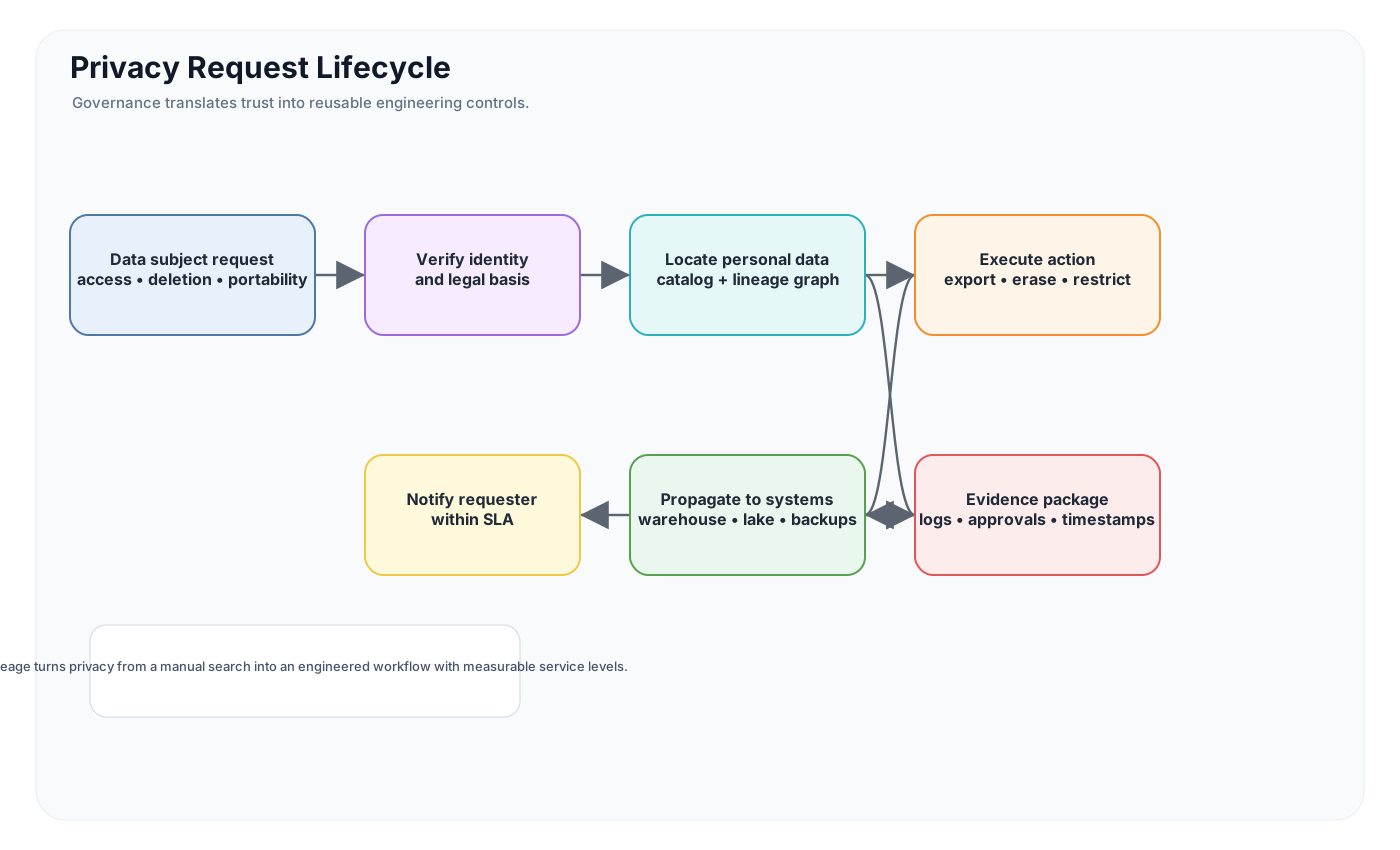
Figure 3:A privacy request lifecycle uses identity verification, catalog search, lineage traversal, execution workflows, and evidence capture to handle access, deletion, portability, and restriction requests.
The engineering pattern is to convert privacy requirements into platform capabilities. A right-to-access request requires a search process that can find personal data across warehouses, lakes, applications, indexes, exports, and archives. A deletion request requires deletion, restriction, or tombstoning in primary stores, derived tables, search indexes, feature tables, vector indexes, exported files, and potentially backups according to the organization’s legal interpretation. A portability request requires export formats and secure delivery. A breach notification obligation requires monitoring, incident classification, timestamped evidence, and contact workflows.
| Compliance requirement | Data engineering capability | Implementation hint |
|---|---|---|
| Know where personal data is stored | Catalog classification and lineage | Tag PII columns and propagate tags through transformations. |
| Limit data to approved purposes | Purpose-aware access policies | Add purpose, legal_basis, and approval_id attributes to sensitive access requests. |
| Retain data only as long as needed | Retention schedules and deletion jobs | Partition by event date; automate lifecycle policies; preserve deletion evidence. |
| Respond to access or deletion requests | Privacy workflow with lineage traversal | Maintain lookup keys, deletion manifests, and derived-asset review lists. |
| Protect cross-border transfers | Region-aware storage and policy checks | Store residency metadata and restrict replication, query, or export paths. |
| Demonstrate compliance | Evidence package | Preserve approvals, logs, quality results, policy versions, and exception records. |
Retention is often harder than access control because copies proliferate. A customer record may exist in raw ingestion files, cleaned silver tables, gold marts, BI extracts, model-training snapshots, logs, operational caches, feature stores, and analyst downloads. Good retention design starts by reducing unnecessary copies. Then it assigns retention policies to storage zones, partitions, and derived assets. Finally, it creates evidence that jobs executed as expected. A deleted or restricted record should leave a trace that the workflow ran, but that trace should not itself expose the sensitive data that was removed.
Compliance should be designed as continuous evidence, not as a once-per-year panic. Every pipeline run can produce evidence: data-quality results, schema checks, lineage events, access-policy versions, masking-policy evaluations, retention-job logs, and privacy workflow outcomes. When evidence is collected continuously, audits become less disruptive and incidents become easier to investigate.
13.5 Data Catalogs, Lineage, and Discovery
A data catalog is the front door to a governed data platform. It helps users answer four questions before they use data: What is this asset? Can I trust it? Am I allowed to use it? Who should I contact if something is unclear?
A useful catalog combines technical metadata with business context. Technical metadata includes schemas, partitions, table sizes, freshness, query history, upstream sources, downstream consumers, transformation code, and policy bindings. Business metadata includes definitions, owners, approved use cases, quality expectations, classification, and glossary terms. Operational metadata includes incidents, freshness status, quality scores, access requests, access-review outcomes, and certification status.
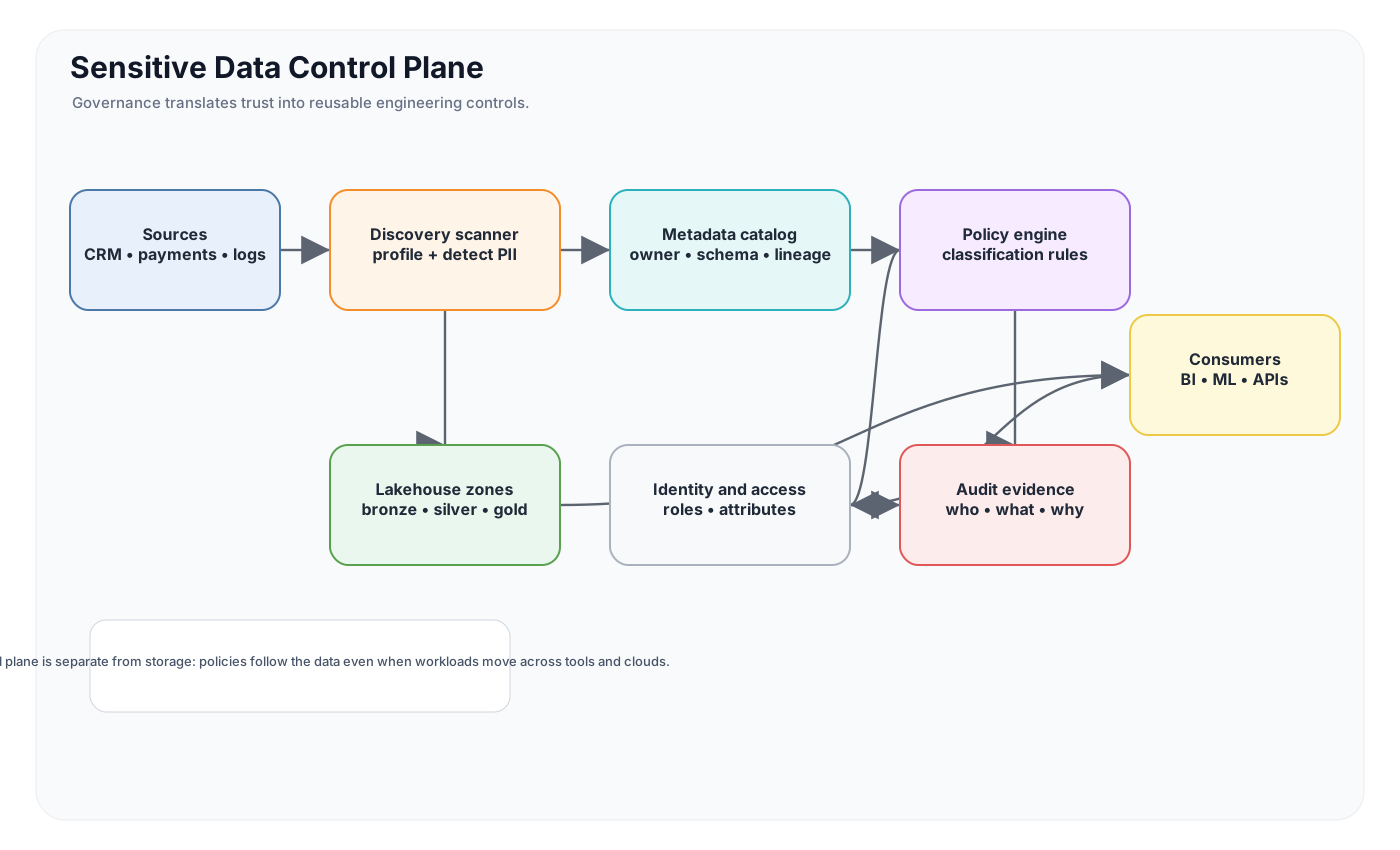
Figure 4:A sensitive-data control plane separates governance policies from storage and processing engines so that classification, access, masking, quality, privacy, and audit rules can follow data across tools.
Popular catalog and governance tools include Apache Atlas, DataHub, OpenMetadata, Amundsen, AWS Glue Data Catalog, Google Cloud Dataplex, Microsoft Purview, and Alibaba Cloud DataWorks Data Map. Tool selection matters less than operating discipline. A catalog with no owners, stale descriptions, and no integration with pipelines becomes another abandoned inventory. A smaller catalog that automatically receives lineage, classification, quality scores, and ownership updates can become a daily workflow tool.
| Catalog feature | Why readers should care | Minimum viable implementation |
|---|---|---|
| Searchable inventory | Users cannot reuse assets they cannot find. | Crawl warehouse, lakehouse, object-storage, and stream assets. |
| Business glossary | Different teams often use the same word differently. | Define critical terms such as customer, active account, revenue, consent, and fulfilled order. |
| Ownership | Questions and incidents need accountable responders. | Require owner and steward fields for certified assets. |
| Lineage | Impact analysis and privacy workflows require dependency maps. | Capture source-to-target lineage from orchestrator and SQL transformations. |
| Classification | Security and privacy controls need sensitivity labels. | Scan for PII and allow steward review of tags. |
| Quality status | Consumers need trust signals before use. | Publish freshness and test status for important data products. |
| Policy visibility | Users need to know why access is granted or denied. | Display masking, retention, and access-policy bindings in the catalog. |
Lineage deserves special emphasis because it connects governance with operations. During a schema change, lineage shows which jobs, tables, dashboards, and features may break. During a privacy request, lineage shows where personal data may have propagated. During an incident, lineage shows downstream blast radius. During access review, lineage helps identify whether a user’s role still matches the datasets they use. Manual architecture diagrams help people understand intent, but operational lineage should be emitted from code, orchestration events, SQL parsers, catalog integrations, and transformation metadata.
13.6 Data Quality as a Governance Control
Data quality is the most visible part of governance because users experience it directly. If a dashboard is late, if revenue is double-counted, or if the customer table has duplicate identifiers, trust disappears quickly. Quality should not be reduced to a few ad hoc checks. It should be treated as a product reliability discipline tied to ownership, contracts, catalog status, and incident response.
A scalable quality program begins with a data contract. A contract states what a producer promises to consumers: schema, primary keys, accepted values, freshness, volume range, update frequency, owner, support channel, and change policy. The pipeline then turns that contract into automated tests. Some checks run before data enters a table. Other checks run after transformation. The result is published as a status in the data catalog so consumers know whether the asset is healthy.
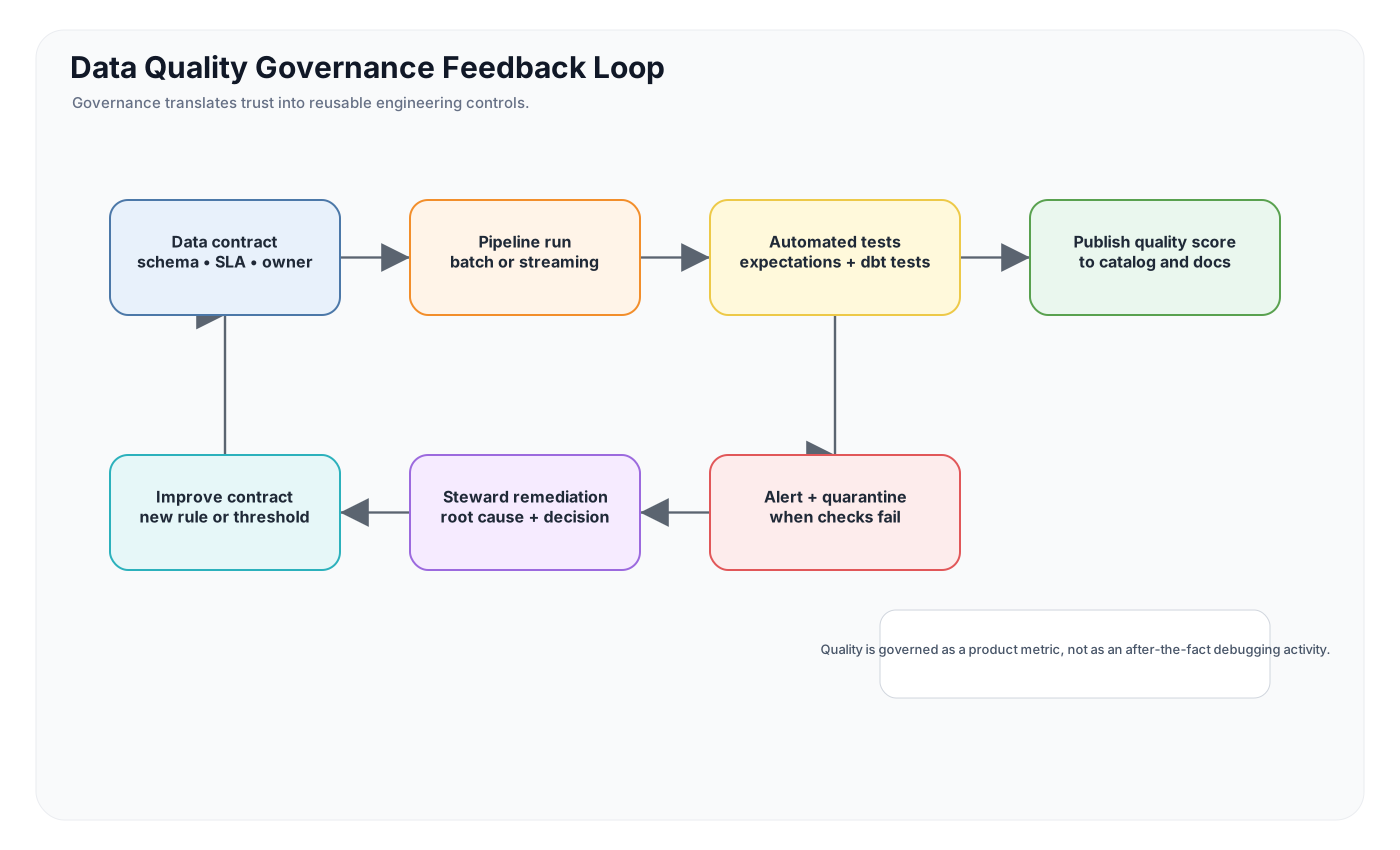
Figure 5:A governed quality loop starts with a data contract, validates every pipeline run, publishes quality results, and sends failed checks into a steward remediation workflow.
Two widely used approaches are expectation-based validation and transformation-level tests. Great Expectations expresses rules as expectations such as “customer_id must not be null,” “order_id must be unique,” and “status must belong to an approved set.” These checks can be executed against Pandas, Spark, SQL databases, or files. dbt tests attach tests directly to transformation models, making quality part of analytics engineering. Both approaches work best when their results feed a catalog, alerting system, or incident workflow rather than ending as local logs.
| Quality dimension | Example rule | Why it matters for governance |
|---|---|---|
| Completeness | customer_id and consent_marketing must not be null. | Missing keys break joins, privacy lookup workflows, and purpose enforcement. |
| Uniqueness | customer_id must be unique in the gold customer table. | Duplicate identities create inconsistent customer views and deletion risk. |
| Validity | country_code must belong to an approved domain. | Invalid domains make residency filters, policies, and reporting unreliable. |
| Freshness | Customer table must be updated by 08:00 each business day. | Consumers need a clear service level and incident trigger. |
| Consistency | Order counts in gold must reconcile with source totals within tolerance. | Financial and operational reporting require traceable reconciliation. |
| Propagation control | Restricted fields must not appear in non-restricted downstream tables. | Classification must follow data through transformations and exports. |
Quality rules should be strict where business risk is high and adaptive where natural variation is expected. A fraud feature table may require strict freshness because stale features change model behavior. A marketing events table may tolerate late-arriving data but must clearly distinguish ingestion time from event time. Governance should therefore define quality by risk and use case, not by a universal checklist.
13.7 Production Design Pattern: Governed Data Product
The most practical way to apply governance is to treat an important dataset as a data product. A data product has consumers, a business owner, a technical steward, a service level, documentation, quality checks, security controls, privacy rules, and support expectations. This pattern works whether the product is a warehouse table, a lakehouse table, a Kafka topic, a feature table, a dashboard dataset, a reverse-ETL audience, or a vector index.
A governed data product should include a product contract. The contract records who owns the asset, what it means, what data it contains, how it is classified, how frequently it is updated, which consumers are approved, and what controls are required. The table below can be copied into an architecture review or catalog template.
| Data product field | Example for TuranMart Customer 360 gold table |
|---|---|
| Business owner | Head of Customer Experience and Retention |
| Technical steward | Data Platform Team, Customer Domain Steward |
| Critical consumers | Marketing analytics, customer support, fraud analytics, churn model, executive dashboard |
| Classification | Restricted PII because it includes identifiers, contact data, behavioral history, and consent status |
| Refresh service level | Daily by 08:00 local business time; incident if later than 30 minutes |
| Quality expectations | Unique customer_id, non-null consent status, valid country code, reconciled account counts, freshness check |
| Access model | RBAC for broad groups; ABAC for region, purpose, approval state, and sensitive columns |
| Masking model | Default masking for phone, passport, email, and exact address; unmasking requires approval |
| Retention | Keep active customer profile while relationship is active; archive or delete according to legal rules |
| Privacy workflow | Lookup by customer_id, traverse lineage, create deletion or restriction manifest, preserve evidence |
| Evidence | Classification report, quality report, query logs, export logs, access review, lineage graph, audit checklist |
The value of this pattern is that it unifies governance, security, privacy, and reliability into one operating unit. Instead of asking whether the platform is “governed” in the abstract, the team can ask whether each critical data product is discoverable, classified, tested, protected, and auditable.
| Design option | Advantages | Trade-offs | Best fit |
|---|---|---|---|
| Central governance team only | Strong standards and clear accountability | Can become a bottleneck and lack domain context | Early policy creation, audit coordination, high-risk exceptions |
| Domain-owned stewardship | Better business definitions and faster issue resolution | Requires training and consistent templates | Data products owned by business domains |
| Platform-enforced policy | Controls are repeatable and auditable | Requires engineering investment and integration | Access, masking, retention, quality gates, and evidence capture |
| Manual review for every access request | High human oversight | Slow, inconsistent, and hard to scale | Rare high-risk access, legal exceptions, incident response |
| Risk-tiered automation | Balances speed and safety | Requires classification accuracy and periodic review | Most analytics and data-product workflows |
Guided Lab: Build a Local Governance Evidence Package
In this lab, you will build a deterministic governance evidence package for TuranMart’s customer_360_gold data product. The lab does not require a cloud account, catalog server, warehouse, or identity provider. Instead, it simulates the artifacts that a production governance workflow should create: classification register, access policy matrix, quality results, privacy request manifest, and audit checklist.
The lab materials are stored under shared/labs/ch13_governance_security_privacy/. The solution guide is stored separately under shared/solutions/ch13_governance_security_privacy/. This separation lets learners attempt the lab before reading the completed answer.
| Lab artifact | Purpose |
|---|---|
data/customer_360_gold.csv | Deterministic TuranMart customer data with identifiers, PII, consent, country, and commercial attributes. |
policies/customer_360_governance.yml | Machine-readable governance contract containing owners, classifications, masking rules, role policies, quality rules, lineage, and retention. |
run_governance_review.py | Local command that reads the dataset and policy, then writes governance evidence under outputs/. |
validate_outputs.py | Deterministic validator that compares generated evidence to expected reference outputs. |
expected/ | Expected classification, access policy, quality, privacy, and audit artifacts. |
tests/ | Automated tests for classification coverage, quality-rule evaluation, access-policy output, privacy lineage, and deterministic evidence. |
Lab Scenario
TuranMart’s customer_360_gold data product has become the default source for customer analytics. It contains customer identifiers, names, phone numbers, email addresses, passport numbers for cross-border delivery verification, country codes, marketing consent, last-login timestamps, lifetime value, loyalty tier, and deletion-request flags. The platform team must prove that the table is governed before it can be certified for broad use.
Step 1: Inspect the Governance Contract
Open policies/customer_360_governance.yml. Identify the owner, steward, classification, refresh service level, column-level classifications, masking rules, approved roles, quality checks, lineage outputs, privacy lookup key, and retention rule. Notice that the policy combines business metadata with enforceable controls. This is intentional. A catalog description that is disconnected from access policy and tests is not enough.
Step 2: Run the Governance Review
From the lab directory, run the local governance command:
python run_governance_review.pyThe command writes output files under outputs/. The important files are classification_register.csv, access_policy_matrix.csv, governance_report.json, privacy_request_manifest.json, and audit_checklist.md.
Step 3: Validate Expected Outputs
Compare the generated files to the deterministic expected outputs:
python validate_outputs.pyA passing validation means the same input dataset and governance policy produced the same evidence as the reference answer.
Step 4: Run the Tests
Run the automated tests:
pytest -qThe tests verify that every column is classified, restricted fields receive masking rules, quality checks detect the known governance issues, privacy lineage includes all derived assets, and the audit checklist contains the required evidence links.
Step 5: Interpret the Audit Checklist
Read outputs/audit_checklist.md. The checklist should identify completed controls, controls that need review, and the evidence location for each item. The objective is not to create paperwork. The objective is to make governance testable. If a reviewer asks why marketing cannot export passport numbers, the answer should point to policy, classification, masking, and audit artifacts.
Expected Learning Outcomes
After completing the lab, you should be able to explain how a governance contract becomes classification, masking, validation, privacy, and audit evidence. You should also be able to adapt the same pattern to a streaming topic from Chapter 9, a transformation model from Chapter 10, an orchestrated pipeline from Chapter 11, or a cloud data platform in Chapter 14.
Common Pitfalls and Operational Lessons
The first pitfall is catalog theater: deploying a catalog but failing to integrate it with pipelines, tests, lineage, ownership workflows, and access controls. Users quickly stop trusting a catalog that contains stale metadata. The second pitfall is security by spreadsheet. Access approvals in spreadsheets do not enforce least privilege unless they are connected to identity and policy systems. The third pitfall is privacy without lineage. A deletion request becomes nearly impossible if the platform cannot find derived datasets, exports, feature tables, indexes, and downstream copies.
Another pitfall is over-classification. If everything is marked restricted, teams either stop using data or create shadow copies. Classification must be precise enough to protect sensitive data while allowing safe reuse of non-sensitive and aggregated data. A related pitfall is under-classification of behavioral data. A single clickstream event may look harmless, but long histories connected to a customer identifier can reveal sensitive patterns.
Teams also forget non-human identities. Service accounts, orchestration jobs, notebooks, BI extracts, and ML training jobs can have more access than humans. They must be governed with the same seriousness. Finally, teams sometimes collect logs but fail to protect the logs. Query logs, export logs, and lineage events may contain dataset names, column names, user identifiers, or sample values. Governance evidence must itself be classified, retained, and protected.
| Pitfall | Symptom | Better practice |
|---|---|---|
| Catalog theater | Glossary exists, but nobody trusts it. | Generate technical metadata automatically and assign stewardship workflows. |
| Security by spreadsheet | Access is approved manually but not enforced in systems. | Connect approvals to IAM, warehouse grants, views, and audit logs. |
| Privacy without lineage | Deletion requests require manual searching across teams. | Capture operational lineage and maintain privacy lookup manifests. |
| Everything is restricted | Teams create uncontrolled extracts to do normal work. | Use risk-tiered classification and safe aggregated or masked products. |
| Forgotten service accounts | Jobs and notebooks retain broad access forever. | Review workload identities, scopes, token age, and job-purpose metadata. |
| Evidence leakage | Audit logs expose sensitive values or identifiers. | Classify evidence artifacts and avoid storing raw sensitive values in reports. |
The IBM breach-cost findings are a useful reminder that complexity increases risk. Multi-environment data breaches were both expensive and slow to contain in the 2024 report.[1] A platform with clear ownership, classification, policy enforcement, and audit evidence is not only easier to govern; it is also easier to investigate when something goes wrong.
Exercises
Choose one table from a previous chapter and classify every column as public, internal, confidential, identifier, PII, restricted PII, or privacy preference. Explain which controls change because of each label.
Design RBAC and ABAC policies for the TuranMart Customer 360 dataset. Include at least four roles and at least three attributes such as region, purpose, approval state, or data classification.
Extend the lab governance contract with a retention schedule for raw, silver, gold, BI extract, and model-training snapshot zones. Explain which evidence each retention job should produce.
Create a data-product contract for the Chapter 9 clickstream topic. Include owner, schema, freshness expectation, quality rules, allowed consumers, classification, retention, and incident trigger.
Compare two catalog tools such as DataHub and OpenMetadata for this chapter’s requirements. Build a selection matrix based on lineage, classification, quality integration, ownership, deployment complexity, and community maturity.
Team exercise: run an access-review meeting for
customer_360_gold. Assign roles for data owner, steward, security reviewer, privacy reviewer, and analytics consumer. Record which access requests are approved, rejected, or modified.
Review Questions
| Question | What a strong answer should include |
|---|---|
| How is governance different from documentation? | Governance connects ownership, metadata, classification, policy enforcement, quality, privacy, and evidence; documentation alone does not enforce or prove controls. |
| Why does classification matter for engineering? | Classification determines access, masking, encryption, retention, lineage review, export control, and audit requirements. |
| What is the difference between RBAC and ABAC? | RBAC grants permissions through roles; ABAC evaluates attributes such as purpose, region, classification, approval state, and context. |
| Why is masking not the same as anonymization? | Masking hides values for a use case, while anonymization attempts to prevent re-identification; masked data may still be personal data if reversible or linkable. |
| How does lineage support privacy requests? | It identifies raw, derived, exported, indexed, feature, and reporting assets that may contain a person’s data or downstream transformations. |
| What should a governed data product contract include? | Owner, steward, meaning, classification, schema, quality rules, access model, masking model, retention, privacy workflow, SLO, and evidence locations. |
| Why should compliance be treated as continuous evidence? | Continuous evidence makes audits less disruptive and improves incident investigation because controls are recorded during normal pipeline execution. |
| What makes governance proportional? | Controls are matched to risk and use case, allowing safe reuse of low-risk data while applying stronger controls to sensitive or regulated data. |
Summary
Governance, security, privacy, and compliance are not separate decorations added after pipelines are complete. They are the control plane of a professional data platform. Governance defines ownership, metadata, classification, quality, and accountability. Security enforces least privilege, masking, encryption, secrets management, and audit. Privacy turns individual rights and responsible data use into engineered workflows. Compliance converts laws, contracts, and internal policies into continuous evidence.
In this chapter we used TuranMart’s Customer 360 scenario to show why governance becomes essential as data products become popular. We mapped governance pillars to platform controls, designed a sensitive-data control plane, studied zero-trust access, connected privacy requests to lineage, treated quality as a governance control, and built a local evidence package with classification, policy, validation, privacy, and audit artifacts. The next chapter moves from governance controls into cloud platform patterns, where these same ideas must be implemented across managed services, cloud-native storage, identity systems, networks, and deployment environments.
References
IBM, “Surging data breach disruption drives costs to record highs,” 2024. https://
www .ibm .com /think /insights /whats -new -2024 -cost -of -a -data -breach -report National Institute of Standards and Technology, “Privacy Framework,” accessed 2026. https://
www .nist .gov /privacy -framework National Institute of Standards and Technology, “Zero Trust Architecture,” NIST Special Publication 800-207, 2020. https://
www .nist .gov /publications /zero -trust -architecture UN Trade and Development, “Global Cyberlaw Tracker,” accessed 2026. https://
unctad .org /topic /ecommerce -and -digital -economy /ecommerce -law -reform /summary -adoption -e -commerce -legislation -worldwide European Commission, “Legal framework of EU data protection,” accessed 2026. https://
commission .europa .eu /law /law -topic /data -protection /legal -framework -eu -data -protection _en