A data engineer is not only a person who moves data from one system to another. A professional data engineer designs reliable data products: pipelines, datasets, storage layers, data contracts, operational checks, and documentation that other people can trust. This chapter introduces the mindset behind that work and turns it into a practical first artifact: a local setup checkpoint for the rest of the book.
By the end of the guided lab, you will verify Git, Python, Docker, Docker Compose, and the book repository on your machine. That outcome may look basic, but it expresses the first production habit of data engineering: before building a pipeline, make the environment reproducible, observable, and explainable.

Figure 1:Chapter overview covering the mindset, roles, lifecycle, and setup checkpoint for data engineering foundations.
Opening Scenario: The First Day at TuranMart
Imagine that you have joined TuranMart, a fictional e-commerce and logistics company that operates across Central Asia. The company sells consumer products online, delivers orders through regional warehouses, and runs marketing campaigns through web, mobile, and partner marketplace channels. Everyone says that TuranMart is becoming “data-driven,” but the first week shows a more difficult reality.
The marketing team wants a dashboard showing daily active customers and campaign conversion. The logistics team wants delivery-delay alerts before customers complain. The finance team wants trusted revenue numbers by region. The fraud team wants to detect suspicious transactions in real time. The AI product team wants clean product descriptions, customer events, and policy documents for recommendation and search systems. The requested outcomes are different, but the root problem is the same: TuranMart has data, yet it does not always have trustworthy data products.
Your first task is not to choose a fashionable technology. Your first task is to think like a data engineer. You need to ask where the data comes from, who owns it, how often it changes, what quality guarantees are required, how failures will be detected, how definitions will be documented, and how future teams will reuse the result. The mindset is both practical and architectural: build small enough to deliver, but disciplined enough to survive production.
| Stakeholder | Pain point | Data engineering translation | Success criterion |
|---|---|---|---|
| Marketing manager | Campaign performance changes depending on who runs the report. | Define customer, campaign, attribution window, event quality, and analytics-ready tables. | One documented conversion metric used by all campaign reports. |
| Logistics operator | Late orders are discovered only after customers complain. | Ingest operational events, process them with clear freshness expectations, and expose alert-ready data. | Delay-risk signals arrive before the support team receives complaints. |
| Finance analyst | Revenue by region does not reconcile across spreadsheets. | Model orders, payments, refunds, currencies, and reconciliation rules. | Daily revenue totals can be traced to source transactions. |
| Fraud analyst | Suspicious transactions are reviewed too late. | Build streaming inputs, feature checks, and operational monitoring. | High-risk transactions are visible while action is still possible. |
| AI product team | Search and recommendation features use inconsistent source material. | Prepare documents, metadata, embeddings, and retrieval-quality evaluation data. | AI features use governed, versioned, and testable data assets. |
This book will return to TuranMart repeatedly. The point is not the fictional company itself; the point is that realistic data engineering is always connected to a business process, a user, a service-level expectation, and an operating model.
Learning Objectives
By the end of this chapter, you should be able to explain data engineering as a production discipline, not merely a collection of tools. You should also be able to prepare and document the local environment used throughout the book.
| Objective | What you should be able to do | Evidence in the guided lab |
|---|---|---|
| Define the discipline | Explain how data engineering turns raw operational data into reliable data products. | A short written definition in setup_report.md. |
| Understand collaboration | Compare the responsibilities of data engineers, analysts, scientists, architects, analytics engineers, and ML engineers. | A role-to-artifact explanation in your notes or class discussion. |
| Think in lifecycles | Describe how requirements, design, development, testing, deployment, and operations connect. | A readiness table that treats setup as an engineering workflow. |
| Prepare the workspace | Verify Git, Python, Docker, Docker Compose, and the book repository. | Version output, branch status, Docker status, and script output. |
| Practice professional habits | Record commands, expected outputs, troubleshooting notes, and cleanup steps. | A complete setup checkpoint report with reproducible evidence. |
Docker packages applications with their dependencies so they can run consistently across environments, and Docker Compose defines multi-container local applications from configuration files.[1] [2] Git gives a project a durable history of changes, which is essential when code, data models, tests, and documentation evolve together.[3] Python virtual environments isolate project dependencies so that one project does not silently break another.[5]
Conceptual Foundation: What Data Engineering Really Builds
Data engineering is the discipline of designing, building, testing, operating, and improving systems that collect, store, transform, serve, and govern data. A narrow definition says that data engineers build pipelines. A better definition says that data engineers build trustworthy pathways from operational reality to analytical and intelligent action.
A pipeline is only one visible part of the work. Behind a useful pipeline are source-system agreements, schemas, data contracts, storage formats, transformation logic, metadata, access controls, tests, monitoring, documentation, and incident response. If any of these parts is ignored, the pipeline may still run, but people may not trust the result.
Working definition: Data engineering is the practice of creating reliable, scalable, observable, governed, and reusable data systems that help organizations make decisions, automate processes, and build intelligent products.
The word reliable matters because downstream users base decisions on the data. The word scalable matters because data volume, velocity, and variety usually grow after a system becomes useful. The word observable matters because production pipelines fail in many ways: source systems change, network calls time out, files arrive late, schemas drift, partitions become skewed, and cost increases silently. The word governed matters because data often contains sensitive, regulated, or business-critical information. The word reusable matters because the best data platforms reduce duplicated work across teams.
| Key concept | Definition | Why it matters at TuranMart |
|---|---|---|
| Data product | A dataset, pipeline, metric, feature table, or interface with defined users, quality expectations, and ownership. | The finance revenue table and fraud feature stream should be maintained products, not accidental files. |
| Data contract | An agreement about schema, meaning, freshness, ownership, and change management between data producers and consumers. | If the checkout service changes payment_status, finance and fraud pipelines need a controlled transition. |
| Reproducibility | The ability to rerun an environment, workflow, or analysis and obtain the same meaningful result. | Every reader and team member should be able to start the same lab services and compare expected output. |
| Observability | The ability to understand system health from logs, metrics, lineage, checks, and alerts. | A late or incomplete order pipeline should be detected before the morning dashboard is trusted. |
| Governance | The policies and controls that make data secure, documented, compliant, and accountable. | Customer consent, regional access, and audit trails must be handled before analytics and AI systems scale. |
A mature data engineer therefore thinks in systems. The central question is not “How do I move this file?” but “How will this data product behave when source data changes, when usage grows, when a stakeholder questions the number, or when the pipeline fails at 02:00?”
The Modern Data Team
A data platform is built by a team. Titles vary across companies, but the collaboration pattern is consistent: data engineers create dependable foundations so that analysts, scientists, product teams, and business leaders can use data safely and effectively.
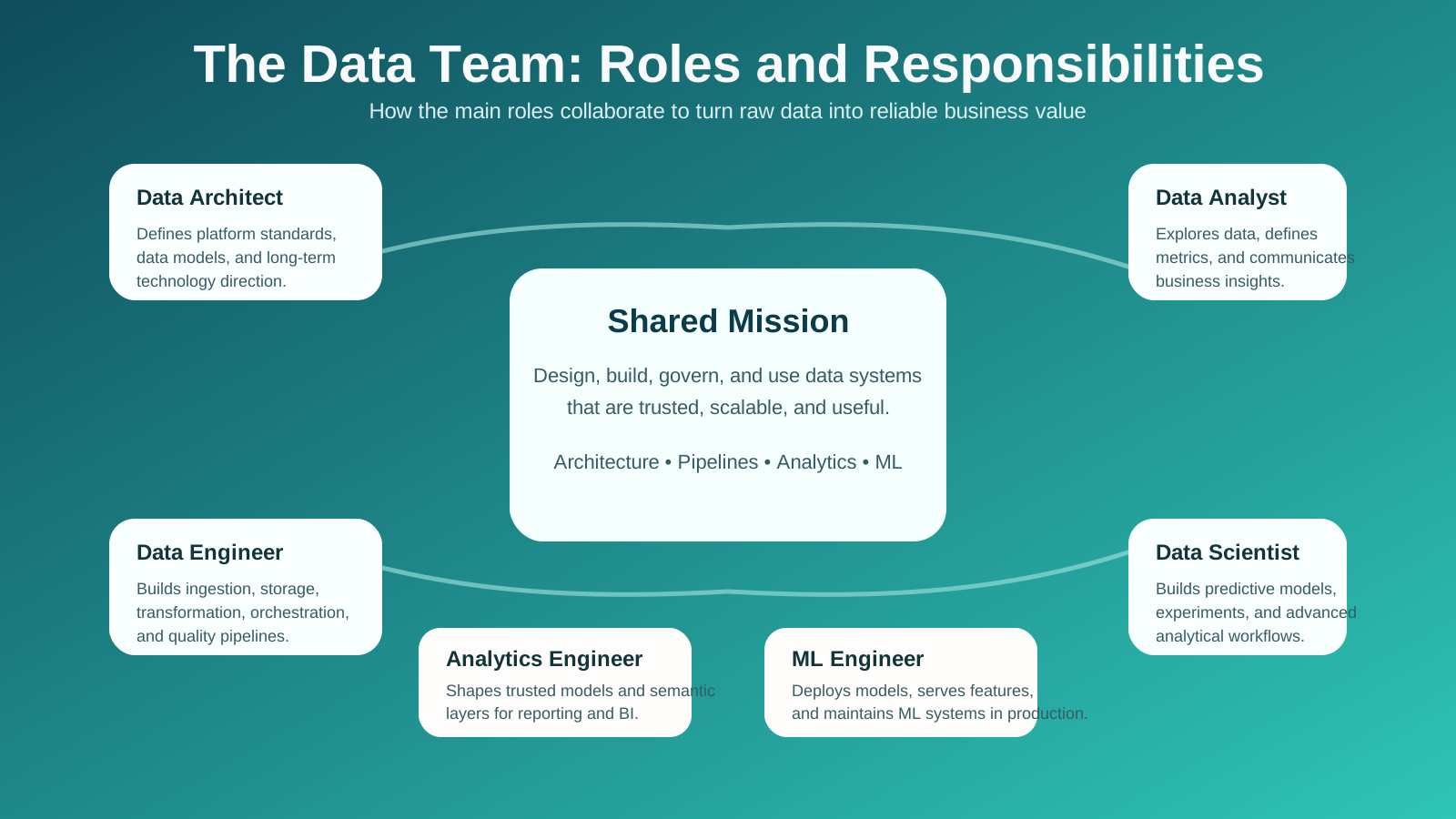
Figure 2:Typical roles in a modern data team and their collaboration points.
The data architect defines the long-term structure of the data ecosystem. The data engineer implements and operates the pipelines, storage layers, transformations, and automation that make the architecture real. The data analyst converts trusted datasets into business understanding. The data scientist uses statistical and machine learning methods to make predictions or optimize decisions. The analytics engineer focuses on transformation quality, semantic consistency, testing, and documentation. The machine learning engineer turns models into production systems.
| Role | Primary concern | Typical output | How the data engineer helps |
|---|---|---|---|
| Data architect | Long-term platform coherence. | Reference architecture, standards, and decision records. | Implements patterns and provides operational feedback. |
| Data engineer | Reliable data systems. | Pipelines, storage layers, tests, orchestration, and monitoring. | Owns the production path from source to serving layer. |
| Data analyst | Business interpretation. | Dashboards, metrics, and analytical narratives. | Receives clean, documented, queryable datasets. |
| Data scientist | Predictive and statistical modeling. | Models, experiments, features, and evaluations. | Receives trusted training data and reproducible feature pipelines. |
| Analytics engineer | Transformation quality. | Curated models, semantic layers, and documentation. | Shares data modeling, testing, and CI/CD practices. |
| ML engineer | Model productionization. | Training workflows, model services, and monitoring. | Shares feature, orchestration, and observability infrastructure. |
A useful way to understand the data engineer’s place in this team is to treat data engineers as builders of interfaces. They build interfaces between operational systems and analytical systems, between raw data and trusted data, between batch and streaming use cases, between human analysis and machine learning, and between local development and production deployment.
The Data Engineering Mindset
The data engineering mindset is a set of habits that protect the usefulness of data over time. Tools change quickly, but these habits remain stable. A good data engineer asks practical questions early, documents assumptions, automates checks, and expects systems to fail in recoverable ways.
The first habit is start from the user and the decision. A dataset is not valuable because it exists. It is valuable because it supports a decision, a product feature, an operational alert, a compliance obligation, or an experiment. If the user needs hourly freshness, a monthly batch pipeline is not sufficient. If the user needs audited revenue, approximate event counts are not sufficient.
The second habit is design for change. Source systems evolve. New columns appear, old columns disappear, business rules change, and volumes grow. A brittle pipeline treats every change as an emergency. A professional pipeline has schema checks, versioned transformations, test data, and clear ownership.
The third habit is make quality visible. Data quality should not depend on someone noticing a strange dashboard manually. Quality rules should be encoded as tests and monitored as part of normal operations. In later chapters, you will use these ideas when working with schemas, transformations, orchestration, observability, and governance.
The fourth habit is prefer reproducibility over heroics. A pipeline that works only on one laptop is not a production asset. A notebook without dependencies, a script without tests, or a Docker service without documented ports creates hidden risk. Reproducibility is why this chapter begins with a local setup checkpoint.
| Mindset principle | Poor habit | Professional habit |
|---|---|---|
| User orientation | Build whatever the requester asked for literally. | Clarify the decision, freshness, quality, and consumption pattern. |
| Reproducibility | Run commands manually and remember what worked. | Use Git, documented commands, dependencies, and repeatable environments. |
| Reliability | Fix failures only after users complain. | Add tests, monitoring, retries, and clear ownership. |
| Scalability | Assume tomorrow looks like today. | Anticipate growth in data volume, consumers, and complexity. |
| Governance | Treat access and privacy as later concerns. | Classify data, control access, and document lineage from the beginning. |
| Cost awareness | Make the system fast at any price. | Balance performance, freshness, storage, and compute cost. |
The Data Engineering Lifecycle
Production data work follows a lifecycle. The order is not always perfectly linear, but the same concerns appear in nearly every successful project: understand the requirement, design the system, implement it, test it, deploy it, operate it, and improve it.
| Lifecycle phase | Main question | Typical evidence of completion |
|---|---|---|
| Requirement discovery | What business problem are we solving? | User story, metric definition, source inventory, freshness requirement, and acceptance criteria. |
| Architecture and design | How should data flow through the system? | Architecture diagram, data model, tool choices, security assumptions, and trade-off notes. |
| Development | How do we implement the pipeline and data model? | Code, configuration, schemas, transformations, and local test runs. |
| Testing and validation | How do we know the output is correct? | Unit tests, data quality checks, sample outputs, reconciliation queries, and reviewed logic. |
| Deployment | How does this become a repeatable production workflow? | CI/CD workflow, orchestration schedule, environment variables, and release notes. |
| Operations | How do we keep it healthy after launch? | Monitoring, alerts, runbooks, incident records, cost checks, and improvement backlog. |
In the TuranMart example, a request for a customer dashboard might begin as a simple question: “How many active customers did we have yesterday?” A data engineer must clarify what “active” means, which source event proves activity, how late events are handled, how customer identity is resolved, how the metric is tested, where it is stored, who can access it, and what happens if the pipeline fails.
Production Design Pattern: Reproducible Local Data Engineering Workspace
The first design pattern in this book is the reproducible local workspace. A local workspace is not production, but it should behave enough like production to support learning, testing, and debugging. The goal is to make every reader start from a comparable baseline before the book introduces databases, object storage, streaming, orchestration, observability, cloud patterns, and AI data systems.
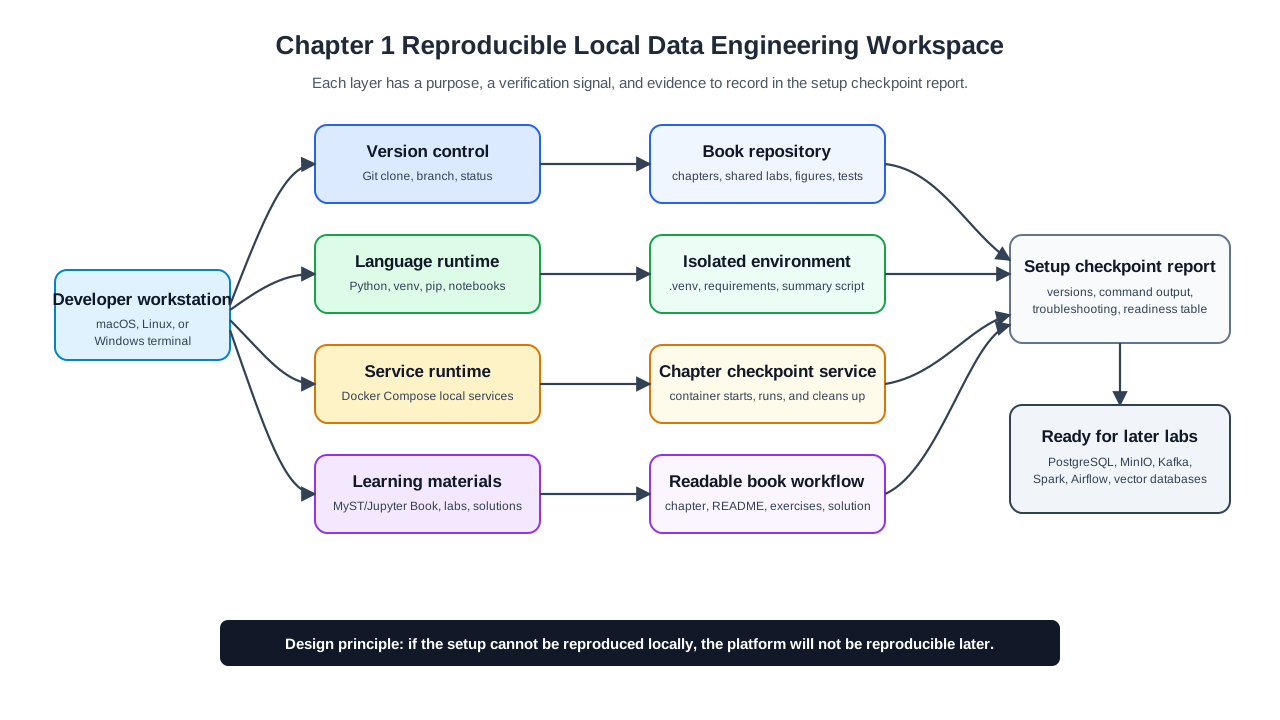
Figure 3:Reproducible local data engineering workspace for Chapter 1.
The workspace has four layers. The version-control layer uses Git to track code and documentation. The language layer uses Python and virtual environments to isolate dependencies. The service layer uses Docker and Docker Compose so that databases, storage engines, message brokers, and notebooks can be started consistently. The documentation layer uses MyST and Jupyter Book to connect chapters, labs, figures, notebooks, and solution guides into a readable learning system.[4]
| Workspace layer | Tooling | Purpose in this book | Verification signal |
|---|---|---|---|
| Version control | Git | Clone the repository and track changes to labs, notebooks, SQL, diagrams, and documentation. | git --version succeeds and the repository has a visible branch and status. |
| Language runtime | Python and venv | Run scripts, notebooks, tests, and small data-processing examples in an isolated environment. | python --version and python -m pip --version succeed inside the environment. |
| Reproducible services | Docker and Docker Compose | Start local services without manually installing each database or platform component. | docker version and docker compose version succeed. |
| Book and lab documentation | MyST/Jupyter Book plus Markdown lab files | Keep prose, commands, expected output, figures, and solutions reviewable. | Chapter links open and the lab materials are present. |
| Design option | Advantage | Limitation | Recommended use in this book |
|---|---|---|---|
| Install all services directly on the laptop | Can be fast for one familiar tool. | Hard to reset, hard to document, and different across operating systems. | Avoid for multi-service labs unless instructed. |
| Use Python virtual environments only | Excellent for scripts and notebooks. | Does not isolate databases, brokers, object storage, or networked services. | Use for Python dependencies in every chapter. |
| Use Docker Compose for services | Reproducible, easy to start and stop, and close enough to production topology for learning. | Requires Docker daemon resources and careful port management. | Default pattern for local databases, storage, streaming, and orchestration labs. |
| Use remote cloud services from the start | Realistic for managed platforms and team environments. | Can create cost, account, network, and permission barriers for beginners. | Introduce later when the reader understands local behavior and trade-offs. |
The pattern is deliberately simple. Chapter 1 does not ask you to run PostgreSQL, MinIO, Kafka, Spark, Airflow, or a vector database. It verifies that your machine is ready to run those systems when they appear later. The setup checkpoint is therefore a small version of a larger production idea: make the environment explicit before you trust the output.
Guided Lab: Create Your Setup Checkpoint
This guided lab is the required Chapter 1 artifact. You will create a setup_report.md file that records evidence from Git, Python, Docker, Docker Compose, and the Chapter 1 lab files. The goal is not to collect identical version numbers across all readers. The goal is to prove that each reader has a coherent, documented environment that can support the rest of the book.
| Lab material | Purpose | Link |
|---|---|---|
| Guided lab README | Main setup-checkpoint walkthrough for Chapter 1. | Open lab README |
| Setup report template | Report file that readers complete while verifying their environment. | Open setup report template |
| Environment summary script | Starter Python script that records local environment evidence. | Open environment summary script |
| Docker Compose checkpoint | Lightweight Compose service used to verify container execution. | Open Docker Compose file |
| Exercises | Independent practice tasks that extend the guided lab. | Open Chapter 1 exercises |
| Solution guide | Reference review guide for instructors and self-study checking. | Open solution guide |
Step 1: Create a Working Directory
Open a terminal and create a workspace for the book. Use a path that does not contain temporary files or synchronized build artifacts if your operating system has trouble with long-running Docker volumes.
mkdir -p ~/data-engineering-in-action
cd ~/data-engineering-in-action
Copy the template or create a report file manually.
cat > setup_report.md <<'EOF'
# Chapter 1 Setup Report

## Machine

- Operating system:
- Terminal:
- Notes:

## Readiness Table

| Check | Status | Evidence |
|---|---|---|
| Git installed | Pending | |
| Repository cloned | Pending | |
| Python environment created | Pending | |
| Docker available | Pending | |
| Chapter 1 service started | Pending | |
| Environment summary completed | Pending | |
EOF
Step 2: Verify Git
Run the following commands and copy the output into your setup report.
git --version
git config --get user.name || true
git config --get user.email || true
Expected output should include a Git version. If the name or email is empty, configure them before contributing to shared repositories.
git config --global user.name "Your Name"
git config --global user.email "you@example.com"
Step 3: Clone the Book Repository
Clone the repository and enter the project directory.
git clone https://github.com/k-farruh/data-engineering-in-action-book.git
cd data-engineering-in-action-book
Then verify that the repository is available.
git status --short
git branch --show-current
A clean repository normally prints no changed files for git status --short. If you see modified files immediately after cloning, record the output and ask your instructor or maintainer before continuing.
Step 4: Verify Python and Create a Virtual Environment
Run the following commands from the repository root.
python3 --version
python3 -m venv .venv
source .venv/bin/activate
python -m pip install --upgrade pip
python -m pip --version
On Windows PowerShell, activation usually uses this command instead.
.venv\Scripts\Activate.ps1If the repository includes requirements.txt, install the dependencies.
python -m pip install -r requirements.txtIf dependency installation fails, do not ignore the error. Record the failing command, operating system, Python version, and the last twenty lines of output in setup_report.md.
Step 5: Verify Docker and Docker Compose
Docker is the foundation for the book’s heavier labs because it allows the same PostgreSQL, MinIO, Kafka, Spark, and other service configurations to be started consistently on different machines.[1] [2]
docker version
docker compose version
If Docker is installed correctly but the daemon is not running, start Docker Desktop or your system Docker service and run the commands again. On Linux, you may need to add your user to the docker group according to your organization’s policy.
Step 6: Start the Chapter 1 Checkpoint Service
Chapter 1 uses a lightweight Compose file rather than starting every heavy service in the book. Run it from the lab folder.
cd shared/labs/ch01_data_engineering_mindset

docker compose up -d

docker compose ps
Expected output should show the service in a running or healthy state. Add the command output to setup_report.md.
Step 7: Run the Environment Summary Script
From the Chapter 1 lab folder, run the starter script and record the output.
python environment_summary.pyThe exact output may differ by operating system, but it should clearly identify your Python executable, Python version, current working directory, and platform details. If the script fails, record the error and verify that your virtual environment is active.
Step 8: Stop the Checkpoint Service and Save the Report
Clean up the service so your machine is ready for the next chapter.
docker compose downComplete the readiness table in setup_report.md.
| Check | Status | Evidence |
|---|---|---|
| Git installed | Pass/Fail | Version output copied here. |
| Repository cloned | Pass/Fail | Current branch and clean/dirty status. |
| Python environment created | Pass/Fail | Python and pip versions from the virtual environment. |
| Docker available | Pass/Fail | Docker and Compose versions. |
| Chapter 1 service started | Pass/Fail | docker compose ps output. |
| Environment summary completed | Pass/Fail | Script output or issue description. |
Commit your setup report only if your instructor or team asks you to do so. In many courses, the report is submitted separately because it may contain machine-specific details.
Expected Output
A successful lab produces a short report, not a complex application. The report should contain version evidence, repository evidence, service evidence, and troubleshooting notes. The exact numbers will differ, but the structure should be similar to the following example.
Git: git version 2.x
Repository branch: main
Python: Python 3.x inside .venv
Pip: pip 2x.x from .../.venv/...
Docker: client and server versions visible
Compose: Docker Compose version v2.x
Compose service: running or healthy
Environment summary: executable, version, working directory, platform
The solution guide explains how an instructor or reviewer should evaluate this evidence. The reviewer should not require every learner to use identical version numbers. The reviewer should verify that the environment is coherent, documented, and capable of running later labs.
Troubleshooting Notes
| Problem | Likely cause | Practical fix |
|---|---|---|
git command not found | Git is not installed or not on the shell path. | Install Git, restart the terminal, and rerun git --version. |
python3 -m venv fails | Python virtual environment support is missing. | Install the platform package for virtual environments or use the Python installer that includes venv. |
| Docker daemon error | Docker Desktop or the system service is not running. | Start Docker Desktop or the Linux Docker service, then rerun docker version. |
| Compose service fails to bind a port | Another process is already using the host port. | Stop the conflicting process or change the host port mapping in the lab Compose file. |
| Package installed but import still fails | pip belongs to a different Python interpreter. | Check which python, python -m pip --version, and virtual environment activation. |
| Repository becomes dirty after setup | Generated files or local reports are inside the repository. | Inspect git status --short and avoid committing machine-specific files unless instructed. |
Common Pitfalls and Operational Lessons
The most common beginner mistake is to treat setup work as separate from engineering work. In reality, the setup is the first pipeline: it has dependencies, commands, expected outputs, failure modes, and a definition of done. If you cannot reproduce your own environment, it will be difficult to reproduce a data platform.
A second pitfall is installing everything globally. Global installation may feel convenient, but it makes projects interfere with each other. Use virtual environments for Python and containers for services whenever possible. This keeps the book’s labs separate from unrelated work on your machine.
A third pitfall is ignoring errors that appear early. A warning about a missing dependency, a failing Docker daemon, or a dirty repository status may become a much larger problem in later chapters. Professional data engineers record the error, isolate the cause, and make the fix repeatable.
A fourth pitfall is confusing tool installation with understanding. Installing Docker does not mean you understand data engineering. It only gives you the ability to run reproducible services. The deeper learning begins when you use those services to model data, test transformations, manage pipelines, and operate systems.
| Pitfall | Symptom | Operational lesson |
|---|---|---|
| Treating setup as a one-time chore | The lab works once but cannot be repeated. | Record commands, versions, and cleanup steps as part of the artifact. |
| Skipping cleanup | Later labs fail because stale containers or volumes remain. | Stop services after each lab and document anything intentionally left running. |
| Ignoring small warnings | Later commands fail for reasons that could have been diagnosed earlier. | Capture warnings while context is fresh and decide whether they matter. |
| Copying commands without interpretation | The report contains output but no explanation. | Explain what each check proves and why it matters for future chapters. |
| Mixing personal files with repository files | git status shows unrelated changes. | Keep personal reports outside the repository unless your instructor specifies otherwise. |
Exercises
The exercises extend the guided lab. They are intentionally practical because the setup checkpoint should produce confidence, not only reading comprehension. Place any exercise files under shared/labs/ch01_data_engineering_mindset/exercises/ or in a personal working folder assigned by your instructor.
| Exercise | Difficulty | Task | Expected evidence |
|---|---|---|---|
| 1 | Easy | Add a “Troubleshooting Notes” section to setup_report.md and describe one issue you encountered or one issue you know how to diagnose. | Updated report section with command and explanation. |
| 2 | Easy | Run docker compose ps before and after stopping the Chapter 1 service. | Two command outputs showing the state change. |
| 3 | Medium | Extend environment_summary.py so it prints the current Git branch when run from the repository. | Script output showing branch information or a clear message when not inside a Git repository. |
| 4 | Medium | Create a Git branch named ch01-setup-checkpoint, make a harmless change to a copy of the report, and inspect git status --short. | Branch name and Git status output. |
| 5 | Challenge | Write a one-page reflection explaining why reproducible local environments matter for later chapters on databases, streaming, orchestration, and ML pipelines. | Reflection with at least three concrete examples from the book plan. |
| 6 | Optional team task | Compare setup reports across two operating systems and identify which differences are harmless and which could affect later labs. | A short compatibility note for the class or team. |
Review Questions
Why is “moving data” an incomplete definition of data engineering?
What is the difference between a pipeline and a data product?
Why does TuranMart need shared definitions before it can trust dashboards, alerts, fraud signals, or AI search?
Which responsibilities are typically shared between data engineers and analytics engineers?
Why is a reproducible local workspace a useful first design pattern for a data engineering book?
What evidence should a reviewer expect in a strong Chapter 1 setup report?
How can a dirty Git repository, wrong Python interpreter, or stopped Docker daemon become a data engineering problem rather than a simple setup issue?
Which parts of the Chapter 1 workflow resemble the later lifecycle of a production data pipeline?
Chapter Summary and Next Step
This chapter introduced the data engineering mindset. A data engineer builds more than pipelines: a data engineer builds reliable, reusable, observable, governed data systems that help an organization make decisions and operate intelligent products. You learned how data engineers collaborate with architects, analysts, scientists, analytics engineers, and ML engineers. You also learned the basic lifecycle that turns a business need into an operating data product.
Most importantly, you completed the first guided lab: the setup checkpoint. This checkpoint prepares your workstation for the rest of the book and establishes the habit of documenting evidence rather than relying on memory. The same habit will appear later when you test data quality, benchmark performance, orchestrate workflows, monitor production systems, and review architectures.
In Chapter 2, you will move from mindset to data itself. You will study data models, data formats, and quality expectations, and you will begin working with the TuranMart dataset that supports the rest of the book.